CMMS and asset management
Maintain everything you keep running.
One record per asset, with every job, part and cost attached to it. Plants, hotels, complexes and fleets.
CMMS and asset management
One record per asset, with every job, part and cost attached to it. Plants, hotels, complexes and fleets.
The problem
Critical assets. Expensive downtime. And the system of record is a group chat. Your team deserves better tools.
In one paragraph
Solmex is a CMMS and an EAM platform in one: the system that plans and records maintenance, and the asset register underneath it. One record per asset, whether that is a line motor, a hotel chiller or a forty-tonne excavator, with every job, part, reading and cost attached to it. The office plans in a browser; the field works from a phone.
Where Solmex runs
An asset is anything you are accountable for keeping in service. Underneath, the record, the work order, the checklist, the spare part and the cost ledger are the same in all four. Only the vocabulary on top of them changes.
Machines that move between sites, burn fuel, are sometimes rented, carry attachments and are serviced on their hour meters rather than the calendar. This is the ground Solmex was built on: a live 520-machine road project, run from the field for a year before it was sold to anybody.
How Solmex runs a fleetMotors, compressors, conveyors, presses and utilities, each with its own service programme, its own spares and its own cost of stopping. Run hours drive the schedule, criticality decides who the technician goes to first, and the store issues are posted against the machine that consumed them.
Chillers, boilers, lifts, pool plant, kitchen equipment and three hundred rooms full of small faults. A technical team works the building rather than a desk, and every job is measured against a guest who must never notice that it happened.
Generators, water pumps, lifts, fire systems, car parks and common areas, kept running by a small technical team that answers to a management board. The board wants to know what was done, when, by whom and what it cost, without asking anyone.
Maintenance doesn't happen in the office
A technician in PPE, a phone in one hand and a spanner in the other. Solmex is built for that moment: scan the plate, read the job, record the work, attach the photo. The office sees it before the technician has packed up.
The actual product
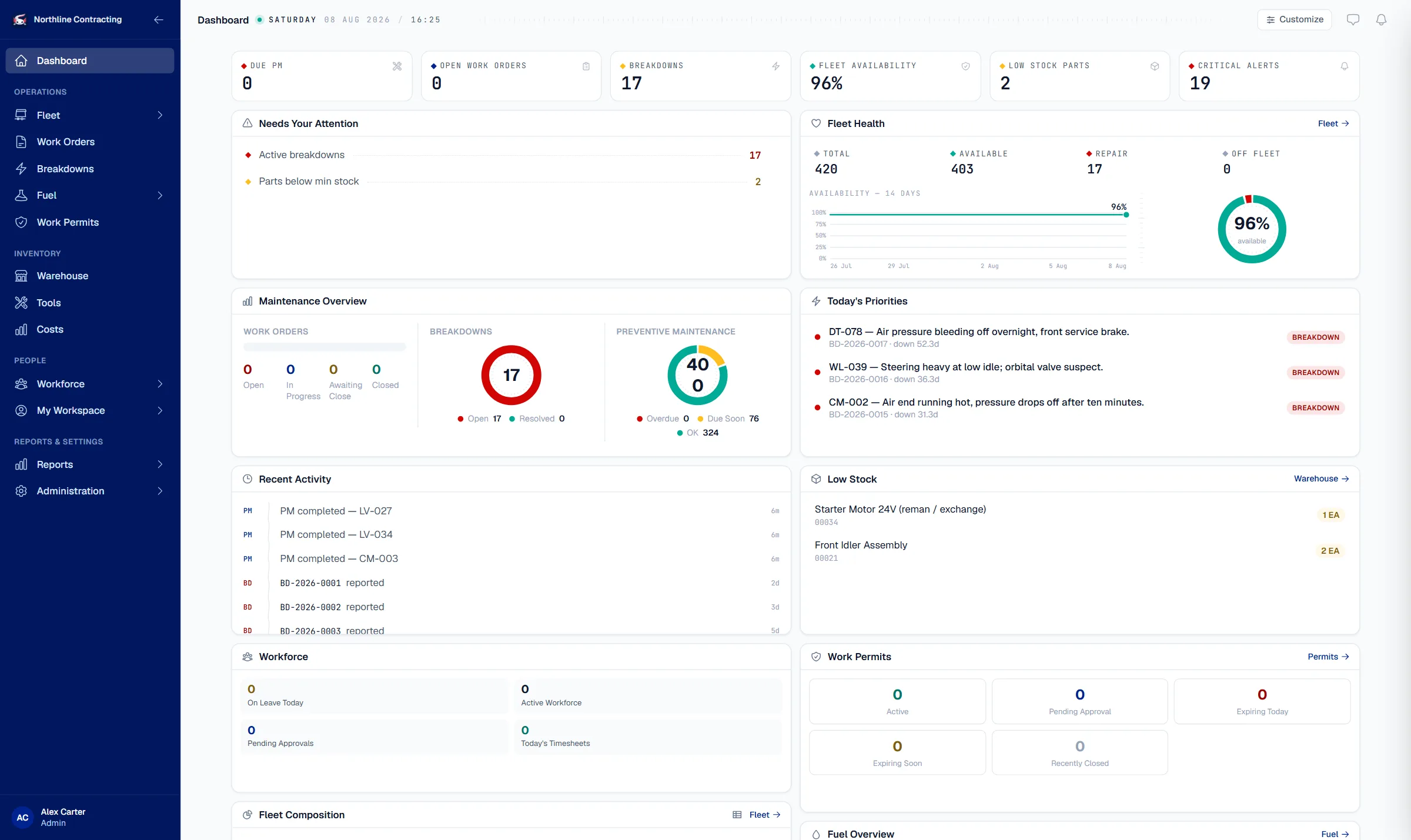
Real screens from a Solmex workspace running a 420-asset fleet, because that is the workspace we have the most of. The register, the fault log, the store and the cost analytics look the same whether the row is an excavator, a chiller or a conveyor motor.
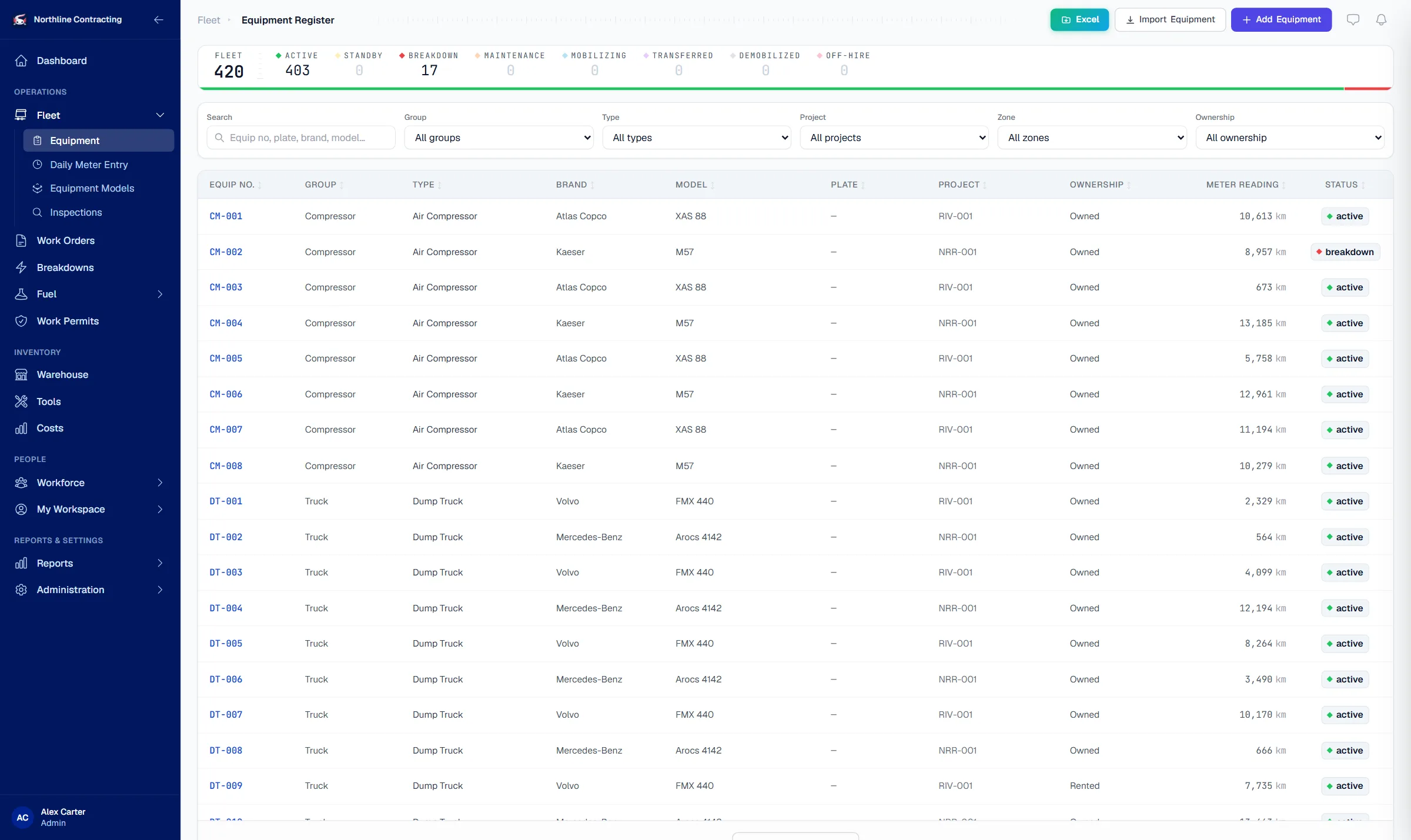 420 machines · live status counts
Filter by group, project, zone, ownership
Status on every machine
420 machines · live status counts
Filter by group, project, zone, ownership
Status on every machine
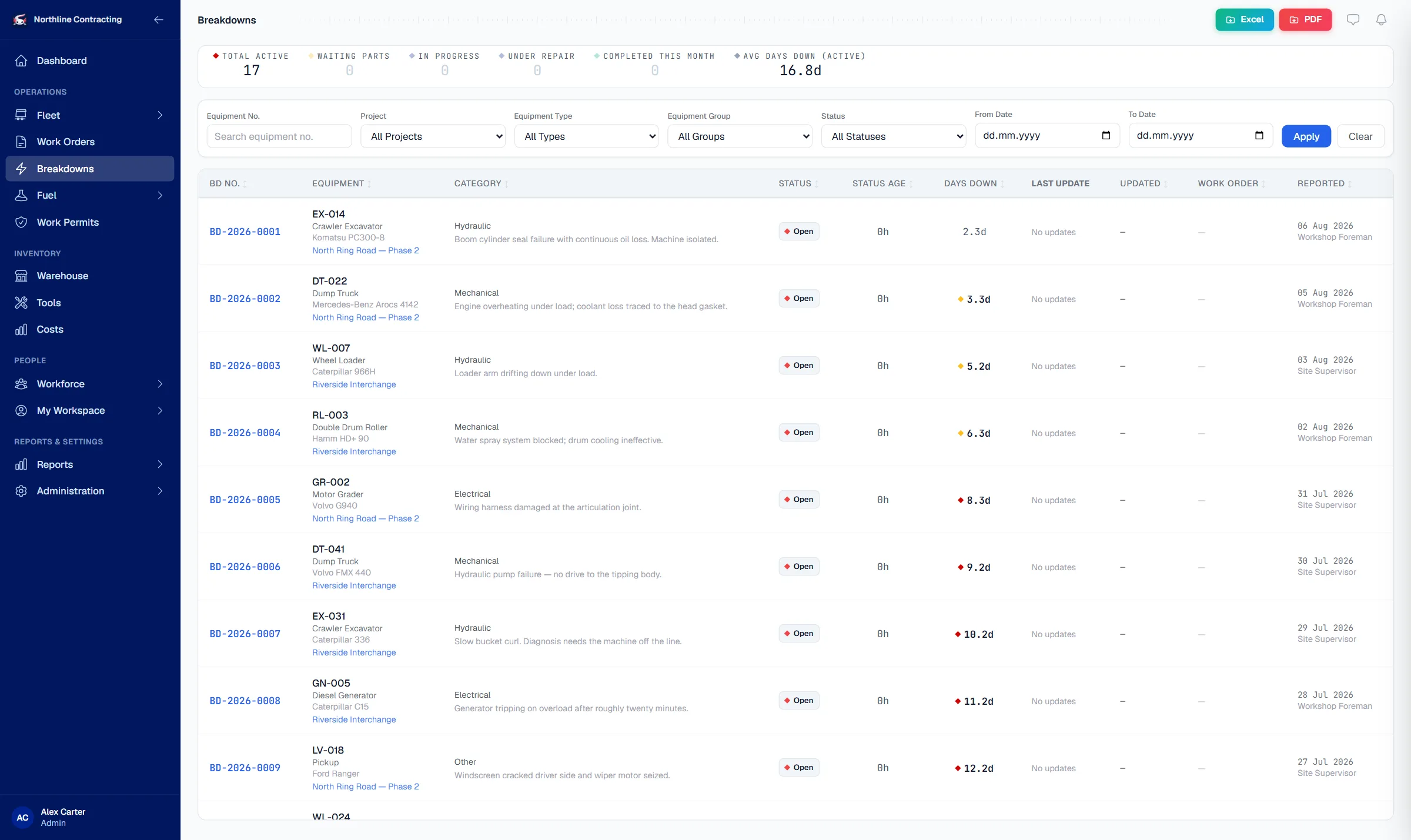 What is down, and for how long
The fault in plain words
Who reported it, and when
What is down, and for how long
The fault in plain words
Who reported it, and when
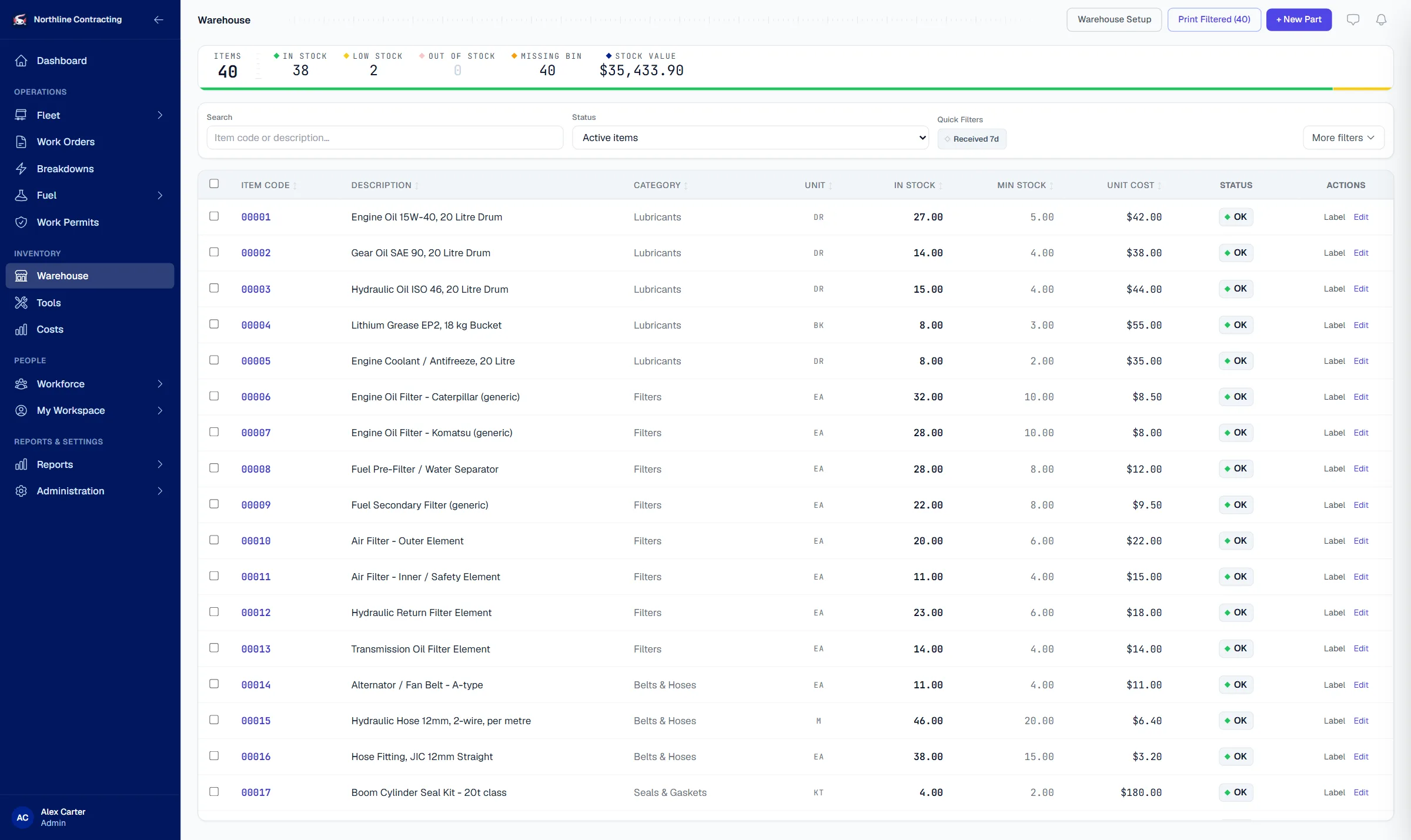 Stock value, counted live
Below minimum, flagged
Print a QR bin label
Stock value, counted live
Below minimum, flagged
Print a QR bin label
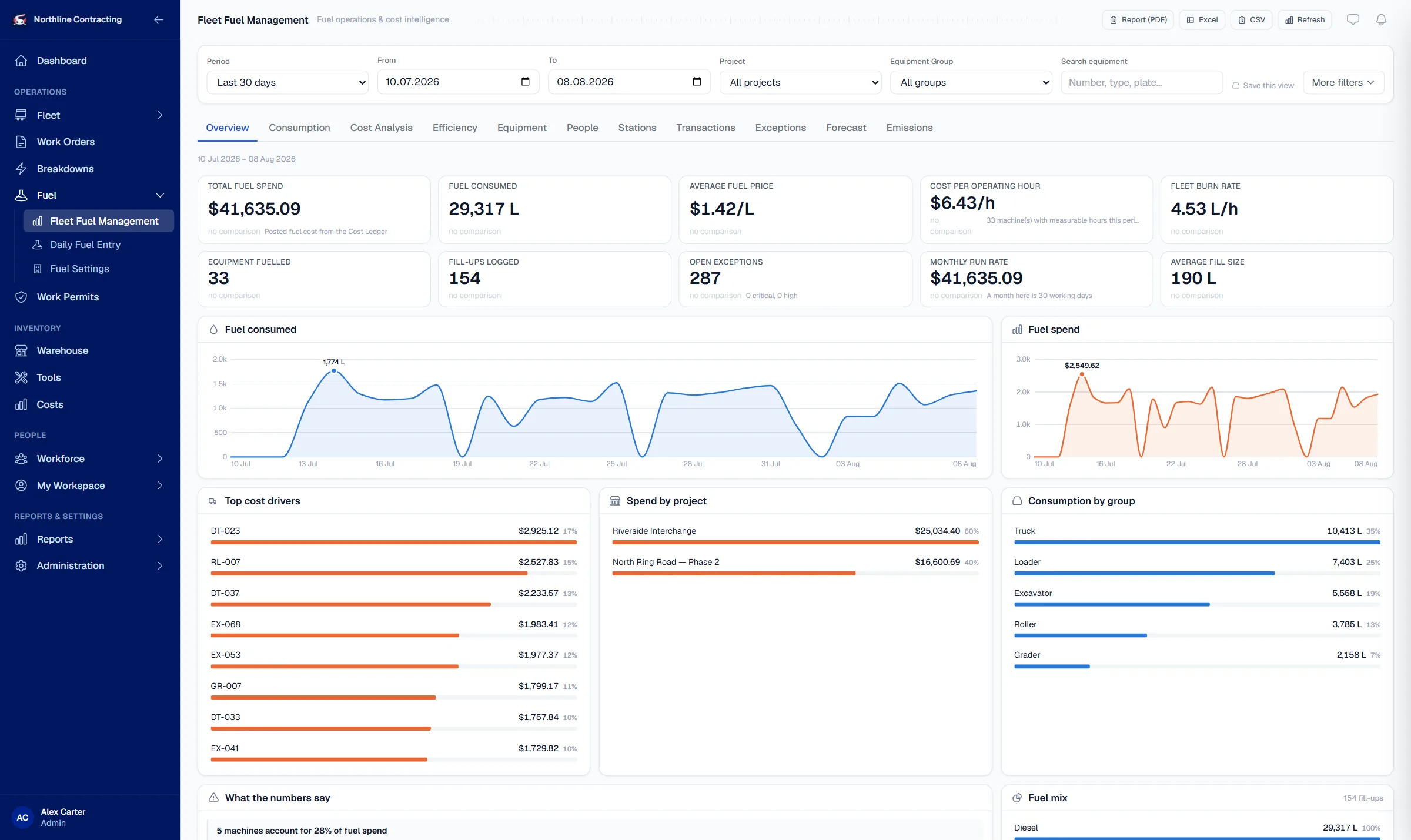 Eleven ways to cut the same data
Cost per operating hour
Where the fuel actually went
Eleven ways to cut the same data
Cost per operating hour
Where the fuel actually went
How the work moves
One job, four hands, no re-typing. The same record travels from the planner's screen to the technician's phone and back; management never has to ask anyone for a status update.
From a reported fault, an overdue service or an inspection finding. The asset, the fault, the priority and the parts it will need.
Notified, opens the job standing at the asset, scans the plate to confirm it is the right one.
Parts issued from the store, hours spent, photos of what was found, a note for whoever comes next. Signed on the screen.
Asset back in service, cost posted against it, history attached to it forever. No end-of-week report to assemble.
Timeline-driven maintenance
Nobody updates a status field in Solmex. The lifecycle is derived from what actually happens: a mechanic starts work, a part is issued, a supervisor signs off. The timeline assembles itself into a complete, trustworthy asset history.
Every step is a real operational event with an author, a timestamp, and evidence. Statuses can't be faked forward or forgotten.
The progress bar your managers see is computed from the record, not from someone remembering to move a card on a board.
Ten years from now, every hour, part, signature, and photo is still attached to the machine it belongs to.
The mobile app
Maintenance software fails in the field, not in the office, because it asks somebody in gloves to fill in a form designed for a desk. Solmex gives them three screens: scan it, do it, sign it. Everything management needs is a by-product of that.
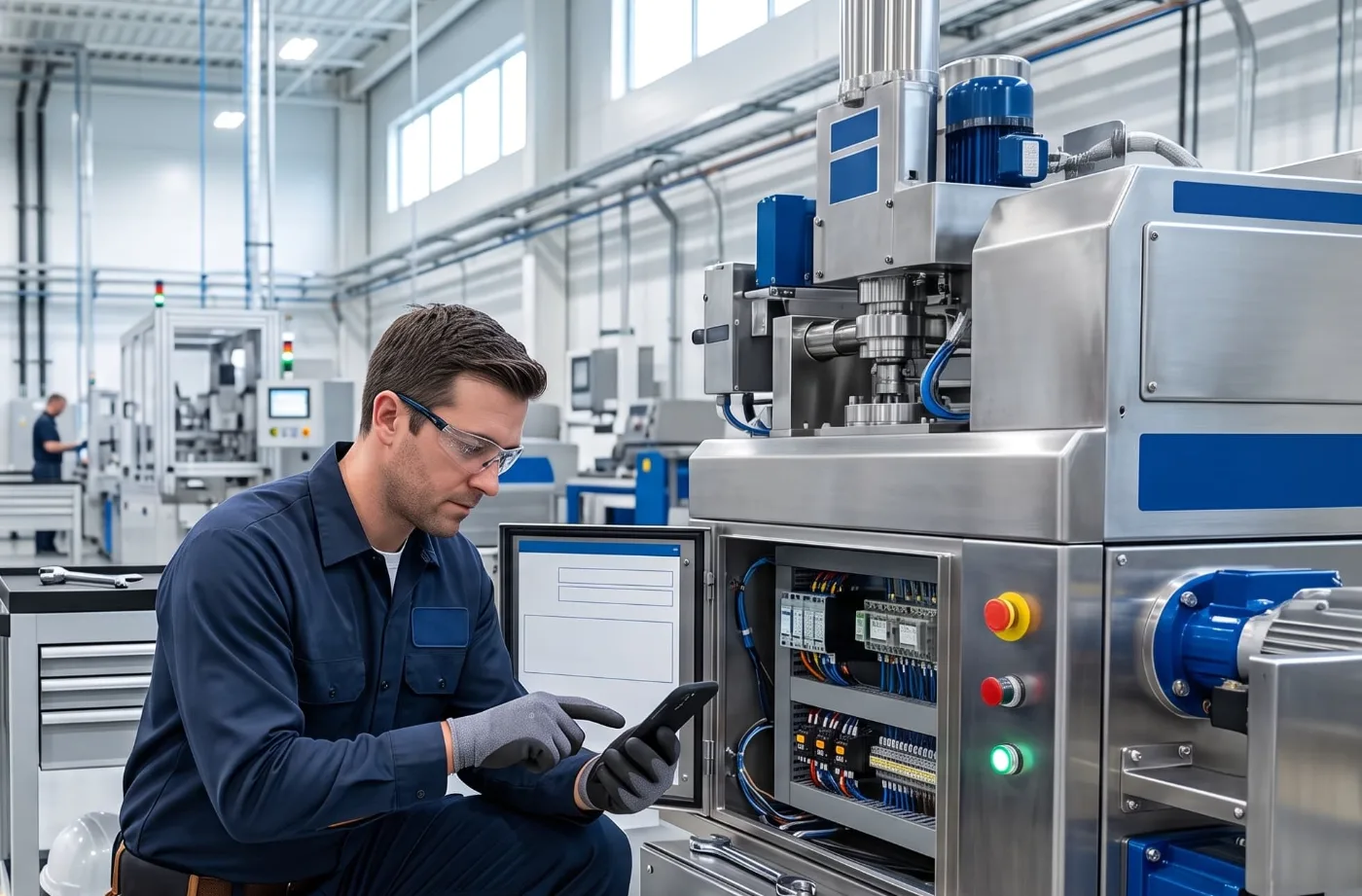
One scan, the whole asset
Solmex prints a QR plate for each asset. Point a phone at it and the asset answers for itself: what it is, what it has done, what it needs and what is currently wrong with it. No asset number to remember, no folder to find.
Solmex generates the label; you stick it on the asset. Weatherproof, and it never needs re-issuing.
Operators, visiting engineers, a contractor on site: a scan opens a safe public card with no login at all.
Signed in, the same scan opens everything: history, meters, documents, costs and the job in front of them.
For the people who sign for it
A maintenance manager should not need a phone call, a site visit and three spreadsheets to answer a board question. In Solmex the answers are a consequence of the work already being recorded.
What is down right now?
Availability is calculated from the status of every asset, not from someone's memory. Anything off-hire, transferred or disposed of is excluded, so the number is your real capacity, with a 14-day trend beside it and the assets that moved it named.
Who is working on it?
Every job has a named technician, a timestamp on each step, the parts drawn against it and a supervisor's signature at the end. When something took eleven days, the record shows exactly which day it waited and what it waited for.
What is this asset costing us?
Store issues, fuel and labour post themselves to the asset that consumed them, alongside manual entries. So you can compare two identical assets doing identical work, and find the one quietly eating its own value.
Are we actually maintaining it?
Services are scheduled against the manufacturer's grid, in hours or in dates, and measured against live readings, so a service done late does not quietly re-phase the whole programme. Inspections, certificates and permits carry their own expiry.
The whole operation
Start with the register and preventive maintenance, and switch on the rest when your team is ready. They were built together, so nothing needs integrating.
The record everything else hangs off.
Explore → Preventive Maintenance02Services fall due from live meters.
Explore → Work Orders03Assign, execute in the field, sign off.
Explore → Breakdowns04Report a fault in seconds, track days down.
Explore → Inspections05Checklists whose findings become work.
Explore → Warehouse06Stock, bin locations and QR labels.
Explore → Tools07Who has what, since when, due calibration.
Explore → Work Permits08Permit to work, approved and signed.
Explore → Workforce09People, certificates, timesheets, leave.
Explore → Costs & Fuel10Every event priced against its asset.
Explore →Questions
The questions maintenance managers, technical chiefs and IT teams ask before they start.
Solmex keeps one record for each asset. Every work order, service, inspection, part, meter reading and cost links to that record, so you see the true cost and the true availability of each one. A spreadsheet cannot do that: it fails when two people edit it at once, it holds no photographs or signatures, and nobody can update it from the roof of a building or the cab of a machine.
Yes. Solmex has a mobile app for the field. Technicians scan the QR code on an asset or a parts bin. They log the progress of a work order. They add photos and signatures. They read inspections and permits on site. Field input is a main feature, not an extra.
You assign a service template to an asset. The template lists the intervals, in run hours (250, 500, 1000) or in kilometres, and each interval carries its own task list. Solmex reads the live meter and shows which service is due, due soon or overdue, against the manufacturer's grid rather than a countdown restarted by the last service. When you complete one, Solmex writes a signed report and updates the asset's history.
Yes. Warehouse issues and fuel records go into one cost ledger. Labor costs and manual costs go there too. You then see the total cost and the period cost for each asset. You do not enter the data two times. Spare parts have a full stock record. This record shows receipts, issues, returns and adjustments. It also shows low stock and prints bin labels.
Yes. Solmex uses a permission for each action, such as view, edit, approve and export. You group these permissions into roles. You make the roles. You can give control of one action to one role only. For example, you can let one role close a work order or approve leave. Solmex writes every change to a key record in an audit log.
Most teams are working in Solmex on their main assets within a few days. We import your asset list from a spreadsheet. We set up your sites, locations and roles. You turn on each module when your team is ready: service, work orders, inspections, warehouse, workforce. The best way to plan it is a short walkthrough using your own assets. Book a demo.
A CMMS is a computerised maintenance management system: the software that plans maintenance, runs work orders and records what was done, with what parts, at what cost. EAM, enterprise asset management, is the wider job around it: the permanent register of what you own, where it is, what it has cost you over its life and when it is worth replacing. Most tools do one well and bolt on the other. Solmex is built as a single record that answers both, which is why the cost of an asset is a consequence of the work recorded against it rather than a separate spreadsheet. Read how it handles preventive maintenance and work orders.
Four kinds of operation: production plants and factories (motors, compressors, conveyors, presses, utilities); hotels and resorts (chillers, boilers, lifts, pool plant, kitchens); residential and commercial complexes (generators, pumps, lifts, fire systems); and equipment fleets and construction (excavators, loaders, trucks, cranes, generators). Anything you keep in service can be an asset, including an attachment mounted on a host machine. Solmex has been proven hardest on the fourth: it has run a live 520-machine road project for a year. See asset management or how it runs a fleet.
Yes. Every asset belongs to a site and to a zone or location inside it, and it can be moved between them without losing any of its history. Registers, dashboards and reports all filter by site, so a site manager sees their own building or project while the head of maintenance sees everything. Each company gets its own isolated tenant, enforced by the database itself, so two businesses never share a register.
Your data lives in a PostgreSQL database in your own tenant, isolated at the database level rather than by an application filter. You can export registers and reports to Excel from the pages you work in, and generated documents such as service reports and permits are PDFs you keep. Every change to a key record is written to an audit log with who changed it and when, so the history is yours and it is readable.
Do you have another question? Talk to our team.
Get started
Send us a handful of your own assets and we will walk you through Solmex using them: your numbers, your service intervals, your problems. Thirty minutes, no slideware.